
Bladder Cancer – Blood in the Urine, Symptoms and Treatment

Bladder cancer is one of the more common cancers of the urinary tract. It occurs most frequently in older adults and is significantly more common in men than in women.
One of the most important signs of the disease is blood in the urine (hematuria). The bleeding may be completely painless and may occur only once, which is why some patients may ignore it. For this reason, blood in the urine requires medical evaluation, even if it disappears on its own.
Bladder cancer is not a single, uniform disease. Some tumors are confined to the superficial layers of the bladder wall and can be successfully treated with local procedures, while others invade the muscle layer and require considerably more intensive treatment.
What Is Bladder Cancer?
The urinary bladder is a hollow organ whose main function is to store urine that travels from the kidneys through the ureters.
The inner surface of the bladder is lined with specialized cells called urothelial cells. The vast majority of malignant bladder tumors arise from these cells. The most common type is therefore called urothelial carcinoma.
Other histological types, such as squamous cell carcinoma or adenocarcinoma, occur much less frequently.
When choosing the appropriate treatment, it is particularly important to determine how deeply the tumor has invaded the bladder wall.
Based on this, bladder cancer is divided into two main groups:
non-muscle-invasive bladder cancer (NMIBC) – the tumor has not invaded the muscle layer of the bladder wall
muscle-invasive bladder cancer (MIBC) – the tumor has invaded the muscle layer of the bladder or deeper tissues
This distinction is extremely important because the treatment of these two groups differs significantly.
What Are the Symptoms of Bladder Cancer?
Blood in the Urine
The most common symptom of bladder cancer is blood in the urine (hematuria). The urine may appear pink, red, or dark brown, although sometimes the amount of blood is so small that it can only be detected by laboratory testing.
Importantly, the bleeding is often painless. Blood may appear in the urine one day and then disappear completely for days or even weeks. The fact that the bleeding has stopped does not mean that its underlying cause has disappeared.
Painless blood in the urine is a symptom that should not be ignored, even if it occurs only once.
Of course, blood in the urine does not automatically mean cancer. It can also be caused by urinary tract infections, kidney stones, an enlarged prostate, and many other conditions. Nevertheless, the cause should always be investigated.
Other Possible Symptoms
Bladder cancer may also cause:
frequent urination
a sudden or urgent need to urinate
burning or pain during urination
a feeling that the bladder has not emptied completely
the need to urinate during the night
These symptoms are much more commonly caused by benign conditions, such as a urinary tract infection. However, if they persist or recur, further evaluation is recommended.
In advanced disease, symptoms may include pelvic or back pain, unexplained weight loss, weakness, and other general symptoms.
Who Is at Increased Risk?
Smoking
Smoking is the most important known risk factor for bladder cancer. Harmful substances from tobacco smoke enter the bloodstream, are filtered by the kidneys, and are excreted in the urine. As a result, these substances remain in prolonged contact with the lining of the bladder.
This is why smoking increases not only the risk of lung cancer, but also the risk of bladder cancer and other cancers of the urinary tract. Quitting smoking reduces the risk and is also beneficial after a bladder cancer diagnosis.
Other Risk Factors
Other factors that may increase the risk include:
older age
male sex
occupational exposure to certain chemicals, for example in some areas of the chemical, rubber, and textile industries
previous radiation therapy to the pelvic area
certain medications and chemical substances
chronic irritation of the bladder
a personal history of urinary tract cancers
However, in many patients, it is not possible to identify one specific cause of the disease.
How Is Bladder Cancer Diagnosed?
If bladder cancer is suspected, the diagnostic workup may include urine tests, imaging of the urinary tract, and direct examination of the bladder.
Cystoscopy
One of the most important diagnostic procedures is cystoscopy. A thin instrument equipped with a camera is passed through the urethra into the bladder, allowing the physician to directly examine the inside of the bladder and identify any suspicious abnormalities.
If a tumor is found, it needs to be removed or tissue needs to be obtained for histopathological examination.
CT Urography
CT imaging, particularly CT urography, can help evaluate the bladder, kidneys, and ureters, as well as surrounding structures and lymph nodes in more advanced tumors.
Depending on the stage of the disease, additional imaging tests may be required to determine whether the cancer has spread beyond the bladder.
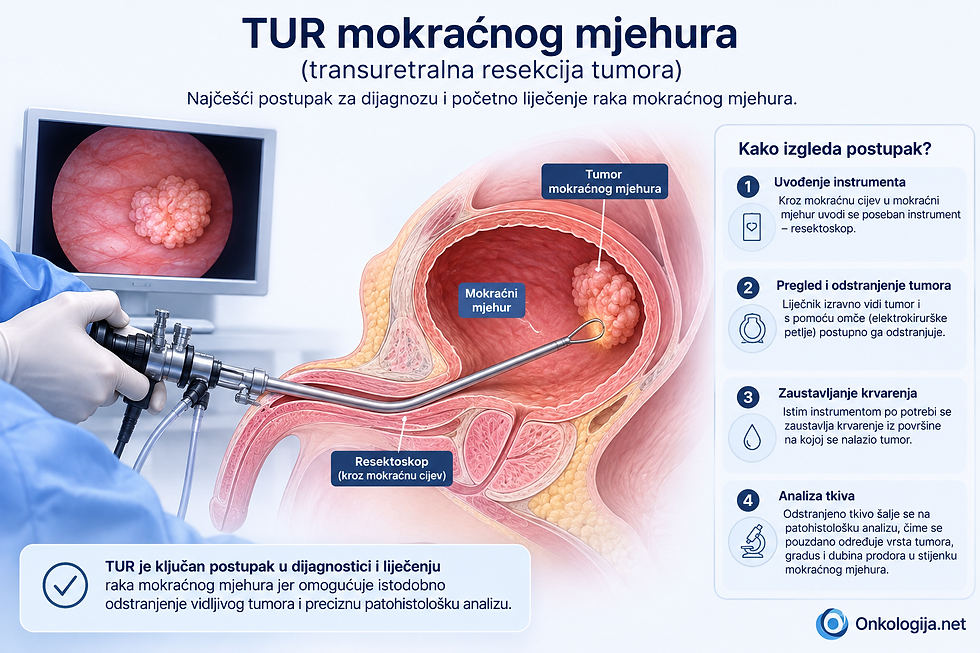
What Is TURBT?
When a suspicious lesion is found in the bladder, the most commonly performed procedure is transurethral resection of bladder tumor (TURBT or TURB).
An instrument is passed through the urethra into the bladder, without the need for an abdominal incision, and the visible tumor is removed.
The removed tissue is then sent for histopathological examination. TURBT has two important roles:
it removes the visible tumor
it allows the tumor type, grade, and depth of invasion into the bladder wall to be determined.
It is particularly important to establish whether the tumor has invaded the muscle layer of the bladder. In certain cases, a repeat TURBT is necessary to ensure complete tumor removal and to determine the stage of the disease as accurately as possible.
Non-Muscle-Invasive Bladder Cancer
At the time of diagnosis, most patients have a tumor that has not yet invaded the muscle layer of the bladder. This group includes tumors classified as Ta, T1, and carcinoma in situ (CIS).
However, not all non-muscle-invasive tumors carry the same risk. The risk of recurrence and progression is assessed based on the tumor stage, grade, size and number of tumors, the presence of CIS, previous recurrences, and other characteristics.
Further treatment is determined according to this risk. For some patients, TURBT followed by regular surveillance is sufficient, while others require additional treatment delivered directly into the bladder.
What Is Intravesical Therapy?
Intravesical therapy involves administering medication through a catheter directly into the bladder.
This allows a high concentration of treatment to act on the bladder lining while limiting systemic exposure to the medication. Depending on the risk of the disease, intravesical chemotherapy or BCG immunotherapy may be used.
BCG Therapy
BCG is a form of local immunotherapy that has been used for decades to treat certain types of non-muscle-invasive bladder cancer, particularly high-risk disease and carcinoma in situ.
BCG stimulates a strong local immune response against cancer cells.
Treatment is administered in a series of instillations, and in selected patients, the initial course is followed by maintenance therapy. Despite treatment, non-muscle-invasive bladder cancer has a significant tendency to recur. Regular follow-up is therefore extremely important.
Why Are Frequent Follow-Up Examinations Necessary?
One of the characteristics of bladder cancer is that it frequently recurs. This does not necessarily mean that the disease has become more aggressive. Some superficial tumors may recur several times over the years and can be removed again.
However, in some patients, the tumor may become more aggressive over time and invade deeper layers of the bladder wall. For this reason, regular follow-up examinations are performed after treatment, most commonly with cystoscopy. The frequency of surveillance depends on the individual risk of recurrence and progression.
Muscle-Invasive Bladder Cancer
When the tumor has invaded the muscle layer of the bladder, it is referred to as muscle-invasive bladder cancer (MIBC).
This form of the disease carries a higher risk of spreading beyond the bladder and requires more intensive treatment.
For localized disease, one of the standard treatment approaches involves chemotherapy before surgery (neoadjuvant chemotherapy) followed by radical cystectomy. In appropriately selected patients, newer perioperative approaches that may include combinations of systemic therapies are also increasingly used.

What Is Radical Cystectomy?
Radical cystectomy is the surgical removal of the urinary bladder, together with the regional lymph nodes and, depending on the patient’s sex and the extent of the disease, other surrounding structures.
After the bladder has been removed, a new way for urine to leave the body must be created.
There are several options. In some patients, urine is diverted through an opening in the abdominal wall into an external collection bag, most commonly using an ileal conduit. In carefully selected patients, a segment of the intestine can be used to create a new bladder – a neobladder, which is connected to the urethra.
The choice depends on the extent of the disease, the patient’s overall health, kidney function, anatomical factors, and individual preferences.
Can the Bladder Be Preserved?
In selected patients with muscle-invasive bladder cancer, treatment aimed at preserving the bladder may be possible.
This approach usually includes:
maximal removal of the tumor with TURBT
concurrent chemotherapy.
This approach is known as trimodality therapy.
It is not suitable for every patient, but in appropriately selected patients it may provide an alternative to radical cystectomy.
What If the Cancer Has Spread Beyond the Bladder?
If the disease has spread to distant organs, it is referred to as metastatic bladder cancer.
Common sites of spread include the lymph nodes, bones, lungs, and liver. Treatment is then primarily systemic, meaning that medications are used to target cancer cells throughout the body.
In recent years, some of the most significant advances in bladder cancer treatment have occurred in the management of advanced disease.
Chemotherapy
Platinum-based chemotherapy has long been a cornerstone of treatment for advanced urothelial carcinoma. The most commonly used combinations contain cisplatin or, in patients who are not candidates for cisplatin, other treatment options such as carboplatin.
Chemotherapy continues to be used at different stages of treatment, including before or after surgery and in metastatic disease.
Immunotherapy
Immunotherapy has significantly changed the treatment of bladder cancer.
Drugs that target immune checkpoints, such as the PD-1 and PD-L1 pathways, help the immune system recognize and attack cancer cells more effectively.
Immunotherapy is now used at different stages of the disease, depending on tumor characteristics, previous treatments, and the patient’s overall condition.
Antibody-Drug Conjugates – A New Treatment Approach
One of the most important recent advances in the treatment of advanced urothelial carcinoma has been the development of antibody-drug conjugates (ADCs).
These drugs combine an antibody directed against a specific target on the cancer cell with a cytotoxic drug. This allows the cytotoxic agent to be delivered more selectively to cancer cells.
One particularly important drug in this group is enfortumab vedotin.
The combination of enfortumab vedotin and the immunotherapy drug pembrolizumab has become one of the key first-line treatment approaches for locally advanced or metastatic urothelial carcinoma. This represents one of the most significant changes in the systemic treatment of this disease in recent years.
Is Targeted Therapy Available for Bladder Cancer?
In some patients, specific molecular alterations can be identified in the tumor that may have therapeutic significance.
One example is alterations in the FGFR2 and FGFR3 genes. In appropriately selected patients with these alterations, drugs that specifically inhibit the FGFR signaling pathway may be used.
As the number of available treatment options continues to increase, molecular testing of the tumor is becoming increasingly important in advanced disease.
Can Bladder Cancer Be Cured?
Yes. Particularly when detected at an early stage, bladder cancer can often be treated successfully.
Non-muscle-invasive tumors generally have a favorable prognosis, although they may recur, which is why long-term surveillance is necessary.
Muscle-invasive bladder cancer is a more serious disease, but when it remains confined to the bladder and surrounding region, treatment is still given with curative intent.
In metastatic disease, complete cure is unfortunately much less common. However, the development of immunotherapy, targeted therapy, and antibody-drug conjugates has significantly expanded the available treatment options.
When Should You See a Doctor?
You should seek medical evaluation particularly if you notice:
blood in the urine
recurrent episodes of blood in the urine
persistent urinary symptoms without a clear explanation
recurrent “urinary tract infections” that do not resolve as expected
unexplained pain in the pelvic or urinary tract area.
The most important message is simple:
Blood in the urine is not normal and its cause should be investigated.
In many cases, the cause will not be cancer. However, if bladder cancer is present, timely diagnosis can significantly affect treatment options and the outcome of the disease.
Bladder Cancer Treatment at Onkologija.net
At Onkologija.net, we provide individualized systemic treatment for patients with advanced bladder cancer, including immunotherapy, targeted therapy, and antibody-drug conjugates, depending on the characteristics of the disease and previous treatment.
Our team has extensive experience with modern therapies for urothelial carcinoma. We were also the first center in Croatia to initiate treatment with antibody-drug conjugates, which significantly expanded treatment options for patients with advanced disease.
Treatment decisions are made individually, taking into account the stage and molecular characteristics of the tumor, previous therapies, kidney function, overall health, and the latest evidence and international treatment guidelines.
For patients who would like to discuss their diagnosis or available treatment options, an oncology consultation or second opinion can be arranged through Onkologija.net.


