
Glioblastoma – Symptoms, Treatment, and What to Expect After Diagnosis

A diagnosis of glioblastoma often comes unexpectedly. The disease may be discovered after the onset of headaches, a seizure, weakness in part of the body, or changes in speech or behavior, and sometimes the first symptoms develop relatively quickly.
Glioblastoma is an aggressive primary brain tumor. Although it is currently treated with a combination of neurosurgery, radiotherapy, and chemotherapy, treatment is challenging because tumor cells can infiltrate the surrounding brain tissue beyond the area that can be seen and removed during surgery.
However, it is important to understand that the course of the disease can vary considerably between patients. It is influenced by age, general health and performance status, the location and extent of the tumor, the possibility of surgical removal, and the molecular characteristics of the tumor itself.
What is glioblastoma?
Glioblastoma is a malignant tumor that arises from glial cells or their precursors in the central nervous system.
According to the current classification of central nervous system tumors, diagnosis is no longer based solely on how tumor cells appear under the microscope. The molecular characteristics of the tumor also play an important role.
Classic adult glioblastoma is generally an IDH-wildtype, WHO grade 4 tumor. This distinction is not merely a matter of terminology. Molecular analysis helps to define the type of tumor more precisely, assess its prognosis, and, in certain situations, guide treatment decisions.
Why is glioblastoma difficult to treat?
One of the most important characteristics of glioblastoma is its infiltrative growth. Magnetic resonance imaging (MRI) can show the tumor mass, but individual tumor cells may spread into the surrounding brain tissue beyond the clearly visible margins of the tumor.
Therefore, even after apparently complete surgical removal of the tumor, we cannot assume that all tumor cells have been eliminated. This is precisely why most patients require additional treatment after surgery.
What symptoms may indicate glioblastoma?
Symptoms depend primarily on which part of the brain the tumor is located in and how large it is.
Possible symptoms include:
headaches, particularly if they are new or progressively worsening
nausea and vomiting
seizures
weakness in an arm or leg
speech difficulties
visual disturbances
problems with balance and coordination
changes in memory and concentration
changes in behavior or personality
drowsiness or other disturbances of consciousness.
These symptoms are not specific to glioblastoma and, in the vast majority of cases, may have other causes. However, new or progressive neurological symptoms require medical evaluation.

How is glioblastoma diagnosed?
When a brain tumor is suspected, the key imaging method is contrast-enhanced magnetic resonance imaging (MRI) of the brain.
MRI can provide detailed information about the location and size of the tumor, its relationship with surrounding structures, and the presence of edema around the tumor. However, imaging alone is usually not sufficient to establish a definitive diagnosis. A definitive diagnosis requires a sample of tumor tissue, obtained during surgery or by biopsy, which is then analyzed histopathologically and molecularly.
Surgery – the first step in treatment
Whenever possible, the first step is neurosurgery. The goal is to remove as much of the tumor as possible without causing unacceptable neurological damage. This is an important distinction.
Maximal resection does not mean removing the tumor “at any cost.” If the tumor involves areas responsible for speech, movement, or other important functions, safety and preservation of neurological function play a crucial role in planning the procedure. For tumors that cannot be safely removed because of their location, a biopsy alone may sometimes be performed to obtain the tissue required for diagnosis.
What happens after surgery?
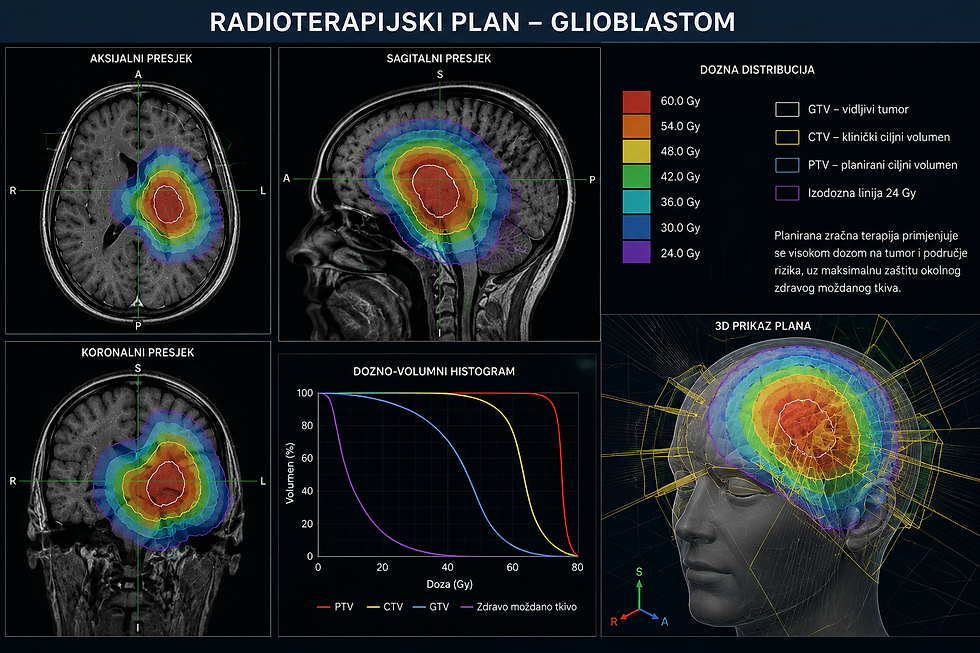
For most patients in good general condition, standard treatment after surgery involves a combination of radiotherapy + chemotherapy with temozolomide, followed, in patients who respond well to treatment, by continued treatment with temozolomide.
During radiotherapy, temozolomide is taken daily. After radiotherapy is completed, there is a recovery period, after which temozolomide is usually administered in cycles. This approach is commonly known as the Stupp protocol.
In older patients or those with poorer general health, treatment may be adapted. Shorter radiotherapy regimens, temozolomide alone, or other strategies may be used depending on the patient's overall health and the characteristics of the tumor.
What is MGMT and why do doctors mention it?
One of the most important findings in glioblastoma is the MGMT gene promoter methylation status.
MGMT is involved in repairing DNA damage, which can also occur spontaneously, thereby protecting normal cells from more significant damage. Temozolomide works in the opposite way, by causing certain types of DNA damage in tumor cells.
If the MGMT gene promoter is methylated, the activity of this repair mechanism may be reduced, meaning that the tumor is generally more sensitive to treatment with temozolomide. For this reason, MGMT status is used as an important prognostic and predictive biomarker, particularly when making treatment decisions for older patients.
However, MGMT promoter methylation does not mean that temozolomide will definitely be effective, just as an unmethylated MGMT promoter does not automatically mean that treatment is of no benefit. The result must always be interpreted together with the other characteristics of the patient and the disease.
Can glioblastoma be completely cured by surgery?
Unfortunately, as a rule, it cannot. Glioblastoma does not have a clear microscopic boundary separating it from healthy brain tissue. Even when a postoperative MRI shows that all visible tumor has been removed, microscopic tumor cells may remain in the surrounding brain tissue.
For this reason, surgery should not be viewed as an isolated procedure, but rather as the first part of multimodal treatment.
How is the disease monitored after treatment?
Patients undergo regular follow-up after treatment, with repeated brain MRI scans playing an important role.
Interpreting these scans is not always straightforward. After radiotherapy and chemotherapy, MRI changes may appear to indicate tumor growth even though they are actually a consequence of treatment. This phenomenon is known as pseudoprogression.
Later on, changes related to radiation-induced tissue damage may also occur. For this reason, MRI findings must always be interpreted in the context of the time elapsed since treatment, the patient's symptoms, and previous imaging studies.
What happens if glioblastoma comes back?
Unfortunately, recurrence is common in glioblastoma. There is no single treatment that is best for every patient with recurrent disease.
Depending on the location and size of the recurrence, the time elapsed since previous treatment, the patient's age, and overall condition, treatment options may include:
repeat surgery
re-irradiation in selected patients
systemic treatment
targeted therapy (bevacizumab) in certain situations
participation in a clinical trial
symptomatic and supportive care.
Treatment decisions are therefore made on an individual basis, ideally within a multidisciplinary team.
Are there new treatments for glioblastoma?
Glioblastoma is an area of very intensive research. Various approaches are being investigated, including targeted therapies, immunotherapy, cancer vaccines, cell-based therapies, new methods of delivering drugs across the blood-brain barrier, and different combinations of existing treatments.
It is important to distinguish experimental treatment being investigated in a clinical trial from treatment that has already been proven to improve outcomes. Particularly with diseases such as glioblastoma, patients and their families may encounter commercial offers for “new” or “revolutionary” treatments. Before making a decision, it is important to determine whether there is high-quality clinical evidence showing that such a treatment is truly effective.
How long do patients with glioblastoma live?
Understandably, this is one of the first questions patients and their families ask after diagnosis, but statistics need to be interpreted with caution. Glioblastoma is a serious disease with an overall unfavorable prognosis, but statistical averages cannot predict how long an individual patient will live.
Prognosis depends on numerous factors, including:
age
general and neurological condition
the possibility of extensive and safe surgical resection
response to treatment
MGMT status
molecular characteristics of the tumor.
For this reason, a discussion about prognosis is most meaningful when all the relevant information about an individual patient's disease is available.
Treating both the disease and its symptoms
Supportive care is also very important in glioblastoma. Corticosteroids may be used to reduce brain edema and the symptoms it causes. Antiepileptic medications are used in patients who experience seizures.
Depending on individual needs, physiotherapists, speech therapists, psychologists, nutritionists, and palliative care teams may also be involved in treatment.
Importantly, palliative care does not mean giving up active cancer treatment. It can be introduced early to improve symptom control and help preserve the quality of life of both the patient and their family.
What is most important after a glioblastoma diagnosis?
After diagnosis, it is useful to know several key pieces of information: whether the tumor was removed and to what extent, the final histopathological and molecular findings, the MGMT status, and the proposed plan for further treatment.
Glioblastoma is a disease that requires collaboration between neurosurgeons, neuropathologists, radiologists, oncologists, and other specialists.
Although it is an aggressive tumor, there is no single disease course that applies to every patient. Treatment decisions should therefore be individualized based on the characteristics of the tumor, the patient's health, and the goals of the individual patient.
How can our team help you?
A diagnosis of glioblastoma often raises many questions – from whether the proposed treatment is optimal and what findings such as MGMT and IDH mean, to whether additional treatment options are available after completion of standard therapy or if the disease recurs.
Through the Onkologija.net team, patients can have an oncology consultation and obtain a second opinion regarding their diagnosis and proposed treatment plan. Based on complete medical documentation, histopathological and molecular findings, and MRI scans, we review the treatment received so far and assess the available options for further management.
For patients who require systemic anticancer treatment, we can assess the available treatment options and organize treatment when it is indicated and can be safely provided at our institution. We pay particular attention to treatment possibilities in recurrent disease, including an assessment of currently available therapeutic options and potential eligibility for appropriate clinical trials.
In addition to treating the disease itself, the patient's quality of life is an important part of our approach. We help manage symptoms and treatment-related side effects and, when necessary, involve other members of our multidisciplinary team.
Our goal is for patients and their families to leave the consultation with a clear understanding of what the findings mean, what realistic treatment options are available, and what the next step should be.


